

Civil Engineering MS
Program Purpose
The Masters of Science program builds on the foundation of skills, breadth, and depth of the undergraduate education to achieve greater competency in civil and environmental engineering. While the undergraduate program prepares students for routine practice (i.e., practice that has long been used and tested by practicing engineers), the graduate program brings students to the state-of-the-art in one or more specialty areas enabling them with the skills necessary to handle problems at the cutting edge.
Curricular Structure
Objectives
Graduates of the MS degree program will be:
- Recognized for their education and accomplishments and sought after by civil and environmental engineering organizations in the government and private sector.
- Leaders within the profession and contributors to state of the art practice in design and analysis of civil and environmental engineering systems
- Advocates of the profession through their examples of faith, character, lifelong learning, service to the community, and high professional ethics as set out in the document "Aims of a BYU Education"
Learning Outcomes
Math and Science - Project Option
Competency in fundamental civil engineering math and science.
Solves applied problems using state of the art tools and methods in at least one of the Civil and Environmental Engineering specialty areas: geotechnical, structures, transportation/materials, or water resources/environmental.
Develops a project plan, including objectives, scope, and timeline with a clear understanding of the intended results.
Appreciates the contributions of others and can research the literature of the chosen specialty discipline.
Articulates challenging research problems and derived conclusions to the intended audience.
Competency in fundamental civil engineering math and science.
Articulates results of challenging design problems to the intended audience.
Solves applied problems using state of the art tools and methods in at least one of the Civil and Environmental Engineering specialty areas: geotechnical, structures, transportation/materials, or water resources/environmental.
Publishes contributions in technical area of research.
Evidence of Learning
The following measures will be used to assess the department's success in helping graduate students achieve the intended outcomes and objectives. The measures will be collected using one of four different tools: natural results of departmental requirements that are already being tracked, committee evaluation of the thesis or project, exit interviews of graduating students, and alumni surveys. The following paragraphs describe which measures will be tracked using each of these tools. The assessment measures will all be stored in electronic databases that can be analyzed and summarized in order to provide evaluation committees with appropriate and timely information. Most of the data will be compiled by means of online forms and always stored in a manner that will not allow responses to be connected to individual names.
Departmental Requirements
Some measures will provide insight on the overall quality of the department and are items that are routinely tracked for each student and will be entered into the measures database as a natural progression of a student passing through the program. These requirements and accomplishments include measures such as:
- GRE Scores
- Graduate school GPA
- Seminar attendance
- Technical presentations and publications
- Completion of a prospectus
- Graduation
Thesis/Project Evaluation
The advisor and advisory committee are in the best position to provide a critical evaluation of the overall and relative success of individual students. At the time of the final defense (or project presentation) the committee will fill out an online assessment form that evaluates the quality of thesis/project writing, presentation, and the student's overall success in graduate school. All measures are given a numerical value between 0-4 and professors use a rubric that attempts to insure that grading is consistent between different faculty members. In addition to providing a numerical value for several different measurements, the committee has the opportunity to record suggestions for program improvements. Such suggestions provide an opportunity for individual reflection and improvement but will also be stored with the assessment database for subsequent review and consideration by the graduate committee and department. The following are the measures evaluated and stored within the graduate assessment database:
- Research
- Originality
- Independence
- Publishable
- Timeliness
- Writing
- Audience
- Organization
- Sentence fluency
- Reasoning and support
- Typographical quality
- Nontextual treatment
- Sources/Documentation
- Oral Presentation
- Verbal clarity and fluency
- Appropriate use of time
- Supporting visual materials
- Response to committees questions
Exit Interviews
Each graduating student is given a questionnaire to fill out. The students are asked to provide feedback to the department on how successful the program was in terms of achieving the program outcomes. Information not easily tracked by the department as listed above will be collected as well as the students feelings about the appropriateness of the program objectives and outcomes and their suggestions for improvements. Specifically the following measures will be gathered:
- Success in meeting program outcomes
- Appropriateness of objectives and outcomes
- Peer-reviewed publications in journals and conference proceedings
- Attendance and/or presentations at national and international conferences
- Scholarly awards
- Service hours performed
- Leadership positions held
- Mentoring responsibilities
- Job placement
- Salary level
Alumni Surveys
At two years, five years, and ten years an attempt is made to contact each graduate in order to update their perception of the success of the graduate program in achieving intended objectives. Whereas the exit interview provides a view of the success in achieving program outcomes, the follow-up interviews will allow the graduates to assess and reflect on the success of program objectives. In addition to asking questions about the perceived success of program objectives, the following specific measures intended to help assess the quality of the program will be gathered and stored for analysis and review:
- Professional licensure
- Publications in journals and conference proceedings
- Technical presentations
- Leadership positions held
- Service hours performed
- Memberships in professional societies
- Salary level
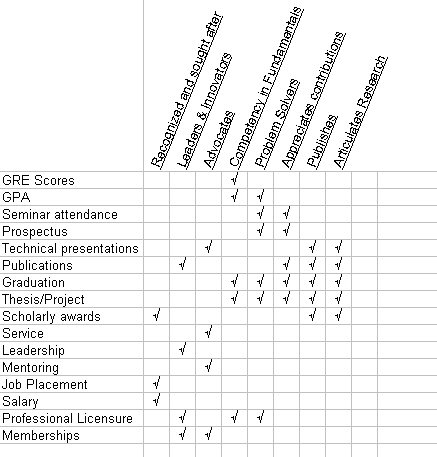
Assessment tools matrix
The following table maps which of the objectives and outcomes each of the individual assessment tools is intended to measure.
Learning and Teaching Assessment and Improvement
The assessment measures will be compiled in databases that can be drawn on for analysis and reviewed by committees organized to provide additional feedback and recommendations for program improvements. These committees all play a role in assessing the overall effectiveness of the graduate program in meeting the stated objectives and outcomes. As appropriately required the objectives and outcomes themselves may be modified. The following committees are organized to aid the department in assessment and improvement: graduate committee, department executive committee, external review board, and college and university committees.
Summaries of the assessment measures and comments from the committees organized to provide oversight and suggestions will be presented to the faculty for discussion each year at the annual fall retreat and at faculty meetings specifically organized for graduate program evaluation as judged necessary by the department's executive council. Faculty will then make final recommendations and vote on program modifications before being officially implemented.
Graduate Committee
This committee meets regularly to discuss graduate program issues and to develop proposals for changes that will lead to improved program quality and achievement of learning objectives and outcomes.
External Review Board
Each year the department will receive a visit from an external review board made up of industry leaders, most of whom are alumni of the program. The board is asked to review the program outcomes and summaries of the assessment measures. The board provides valuable feedback regarding the overall direction of the program and makes suggestions for improvement.
College/University Review
The college and university administration periodically perform program evaluations and provide feedback and suggestions. As requested the assessment measures will be made available to such committees to aid in their evaluations.
Department Executive Committee
This committee is comprised of the department chair, associate chair, graduate coordinator, undergraduate coordinator, and faculty development coordinator. The committee will review assessment measures and suggestions from the graduate committee to determine if further discussion and consideration of changes should be taken before the full faculty.